16 November 1769 - Cook 'discovers' the Waihou River
16 November 1769
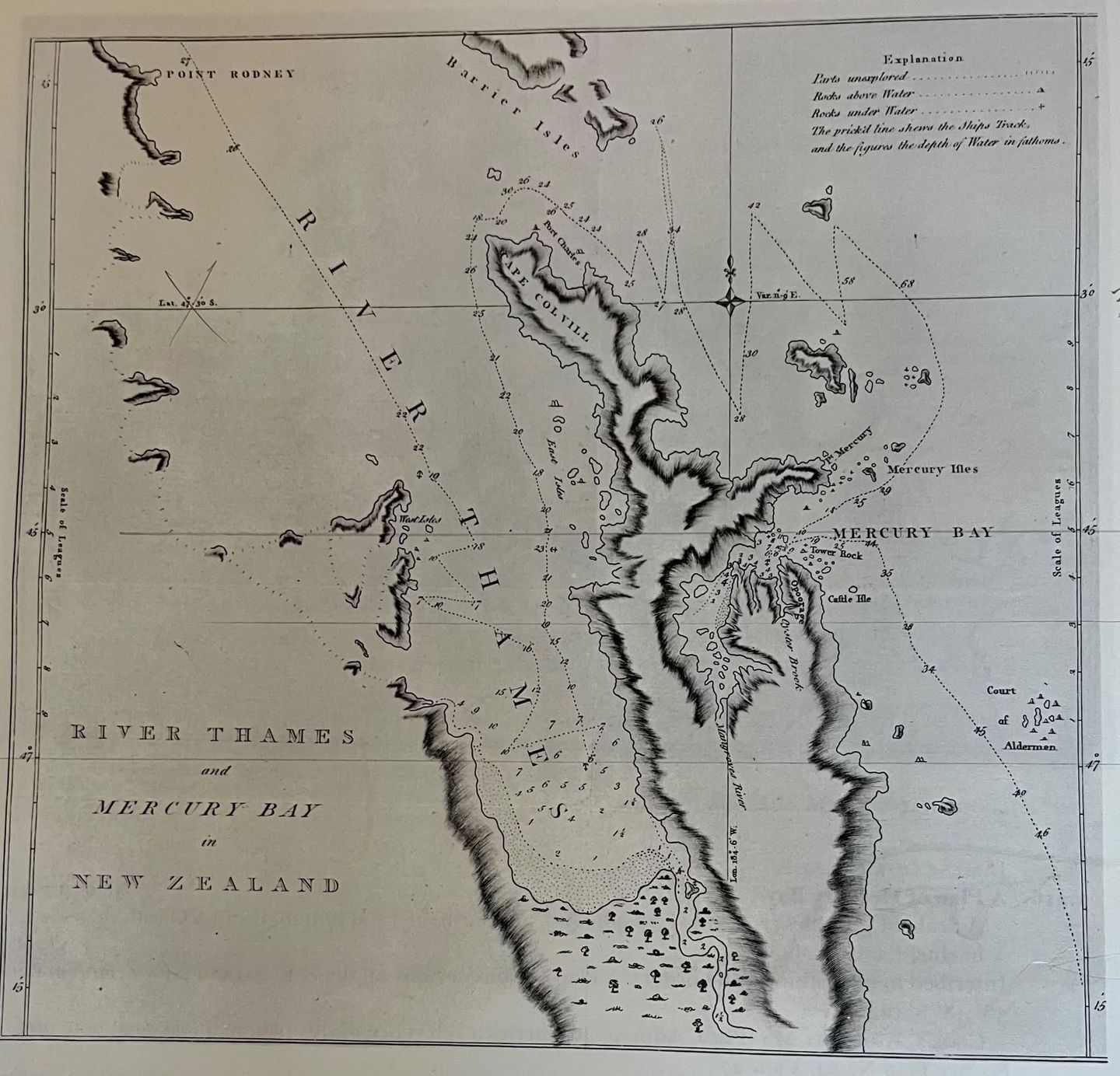
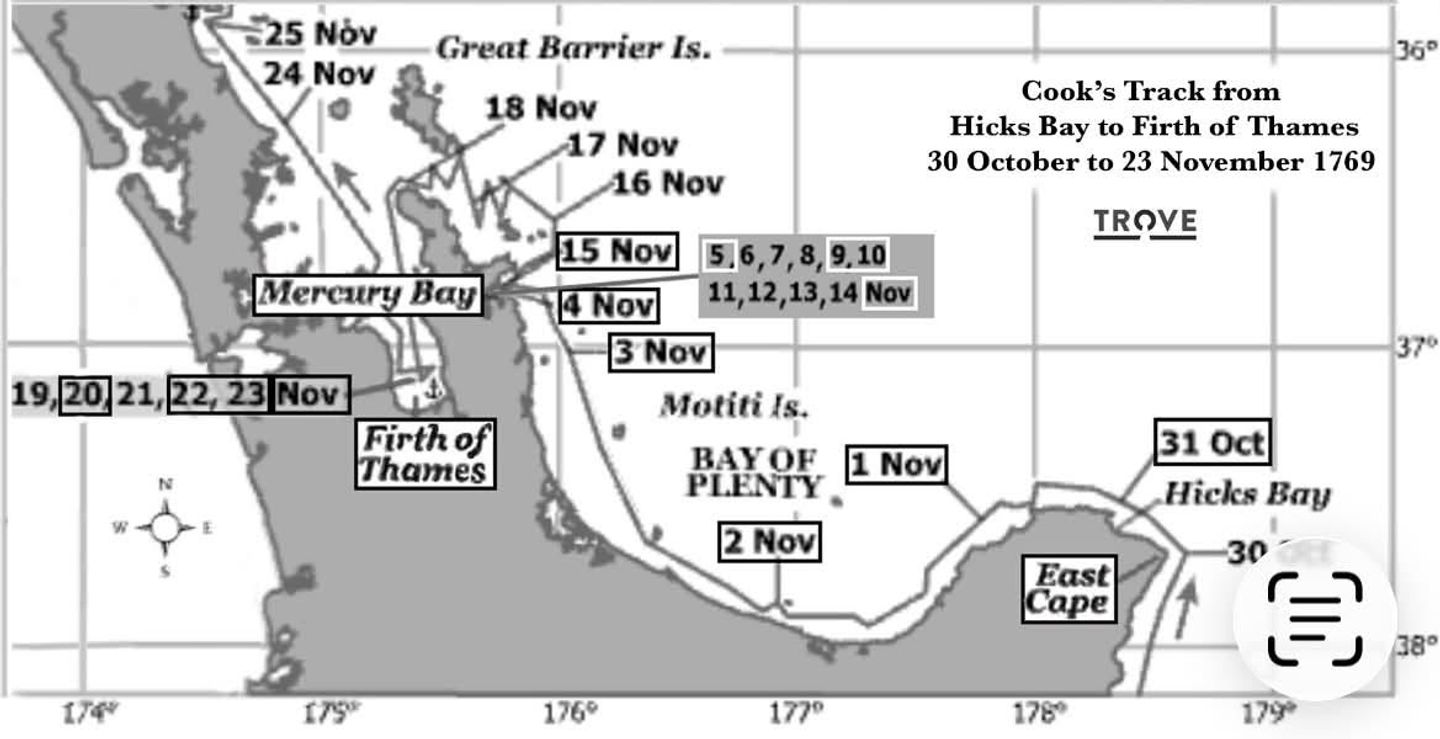
‘At 1 PM having got without the group of islands, which lies off the north head of Mercury Bay [Mercury Isles on the chart], hauled our wind to the Northward’. (Cook)
18th November - ‘At seven (am) we were abreast of a remarkable bare point jotting far into the sea; [Cape Colvill] on it stood many people who seemed to take but little notice of us, but talk together with much earnestness. In about half an hour, we saw canoes put off almost at the same time from several different places and come towards us, on which these people also put off a small canoe they had with them and came likewise towards us, she soon came up with us and had in her 20 people, and soon after another with 35. They sung the song of defiance as usual, which we took very little notice of, in about half an hour they threw three or four stones on board and then departed towards the shore; we thought we were quite clear of them, but they soon returned as if inclined (which I believe is the common policy of these people) to provoke us to show them whether we had or not arms superior to theirs. Tupia who I believe guessed that they were coming to attack us immediately went up upon the poop, and talked to them a good deal, telling them what if they provoked us we should do and how easily we could in a moment destroy them all. They answered him in their usual, cant “come ashore only and we will kill you all”. Well, said Tupia, but while we are at sea you have no manner of business with us, the sea is our property as much as yours. Such reasoning from an Indian who had not had the smallest hint from any of us surprise me much and the more as these were sentiments I never had before heard him give a hint about in his own case. All his preaching however had a little effect for they soon renewed their stone attack, on which a musket ball was fired through one of their boats on which they dropped astern and left us’ (Banks)
On 20th November, a river was discovered. They named the river ‘Thames’, ‘…into which we entered with the first of the flood, and before we had gone 3 miles up it found the water quite fresh. We saw a number of the natives and landed at one of their villages, the inhabitants of which received us with open arms; we made but a short stay with them, but proceeded up the river until near noon’. (Cook)
‘The banks of the river were completely clothed with the finest timber my eyes ever beheld’ (Banks) [White pine/kahikatea – Dacrycarpus dacrydioides].
The one they measured: ‘was as straight as an arrow and tapered but very little in proportion to its length, so that I judged that there was 356 solid feet [108 metres] of timber in this tree clear of the branches. We saw many others of the same sort several of which were taller than the one we measured’. (Cook)
‘We cut down a young one of these trees; the wood proved heavy and solid, too much so for mast but would make the finest plank in the world’. (Banks)
22nd November
When one of the visitors stole the half hourglass out of the binnacle [a case that supports and protects the ship’s compass, located near the helm] and was caught red handed, Lieutenant Hickes, who was the commanding officer, brought him to the gangway and gave him a dozen lashes with the cat o’ nine tails. The rest of his people seemed to agree with the punishment when they knew the cause, and one old man beat the fellow after he had got into his canoe.
On 23rd November they departed the Firth of Thames and kept standing along shore to the north-west.
(The Endeavour Journals - Captain Cook in Australia - John and Clare MacDonald
May be an image of map and text. May be an image of map and text that says "25 Νόν 24 24,Nov Nov Great Barrier Is. 18 Nov 17 Nov 16 Nov 36° Cook's Track from Hicks Bay to Firth of Thames 30 October to 23 November 1769 15 Nov Mercury Bay 14 Νον TROVE 19, 2021,22,23Nov 21, 22,23 Nov Firthof Thames Nov 3Nov Motiti Is. BAYOF PLENTY 1Nov 2Nov 31Oct 31 Oct Hieks Βαν 174 175 East Cape 176° 177° 178 月] 38° 179"